
5G Manufacturing Modernization Report
5G Technology Accelerates American Manufacturing Modernization

New industry report reveals 5G’s transformative impact on factory safety, efficiency and innovation across American manufacturing sector
Industry Report Highlights Strategic Importance
September 16, 2025 – The National Association of Manufacturers and CTIA released a comprehensive report. The study details 5G’s crucial role in modernizing American manufacturing. It examines how manufacturers utilize commercial 5G networks. These implementations advance Manufacturing 4.0 initiatives. The technology enhances factory safety and operational efficiency. It also strengthens national economic resilience and security.
Executive Leadership Perspectives
Jay Timmons, CEO of the National Association of Manufacturers, emphasized 5G’s strategic significance. “5G technology enables Manufacturing 4.0. It positions America as the global center for intelligent manufacturing. Manufacturers leverage 5G to enhance workplace safety and improve efficiency. The technology strengthens organizational resilience through real-time operations. It supports emerging technologies like artificial intelligence effectively.”
Wireless Industry Collaboration
Ajit Pai, President and CEO of CTIA, underscored the critical partnership. “The wireless industry collaborates with manufacturers to drive American innovation. We support productivity and global leadership initiatives. Policymakers must take decisive action to ensure spectrum availability. Additional mid-band spectrum is essential for 5G deployment and expansion.”
Artificial Intelligence Integration
Manufacturers harness 5G’s speed and minimal latency to power AI applications. The Manufacturing Leadership Council’s 2025 survey reveals significant trends. Over fifty percent of manufacturers currently implement AI operations. Sixty-one percent anticipate increased AI investment by 2027. Operational performance and cost reduction drive adoption rates exceeding sixty percent. 5G enables rapid analysis of extensive datasets across multiple applications.
Real-World Implementation Examples
- Immersive Training: VictoryXR and Taqtile utilize AR headsets powered by 5G for employee upskilling
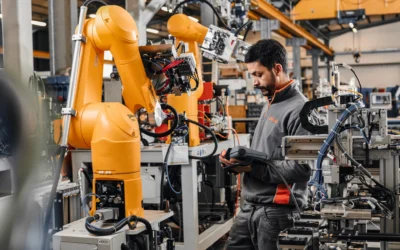
- Autonomous Material Handling: Seegrid’s robots transport components via 5G at Whirlpool facilities
- Advanced Quality Control: Hitachi implements real-time monitoring with machine learning capabilities
- Intellectual Property Protection: Cummins employs secure 5G networks for robotics and defect detection
- Industry-Wide Adoption: General Motors, Rockwell Automation, and Ericsson implement 5G innovations
Economic Impact Assessment
Boston Consulting Group analysis indicates substantial economic benefits. 5G networks will contribute $1.5 trillion to national GDP. The technology will create 4.5 million jobs throughout this decade. This significant impact underscores 5G’s role as a fundamental economic driver.
Professional Analysis: The 5G Manufacturing Ecosystem
5G technology represents more than incremental network improvement. It establishes foundational infrastructure for next-generation manufacturing. For industrial automation professionals, 5G’s low latency enables real-time control applications. The technology transforms areas requiring wireless reliability. It supports flexible production systems and modular automation effectively. The integration with edge computing creates powerful combinations for time-sensitive applications.
Implementation Scenario: Smart Factory Transformation
Challenge: Automotive manufacturer requires real-time coordination between autonomous robots and quality systems.
Solution: Deployment of private 5G network supporting high-speed data transmission.
Outcome: 40% reduction in material handling time and 90% improvement in defect detection accuracy.
Strategic Policy Recommendations
The report identifies critical policy requirements for manufacturing competitiveness. Continued allocation of licensed spectrum remains essential. A robust national 5G strategy must include spectrum pipeline development. This approach ensures American manufacturers maintain technological leadership.
Future Outlook and Industry Transformation
5G technology establishes the framework for American manufacturing’s future. It accelerates innovation cycles and enhances safety protocols. The technology enables real-time decision-making and strengthens industrial infrastructure. 5G’s transformative potential extends beyond individual factories. It reshapes entire supply chains and manufacturing ecosystems.
Frequently Asked Questions (FAQs)
How does 5G specifically benefit manufacturing operations?
5G provides lower latency, higher reliability, and greater device density support. It enables real-time control and massive IoT deployments previously impossible.
What manufacturing applications benefit most from 5G?
Autonomous mobile robots, augmented reality training, and real-time quality control represent primary beneficiaries of 5G capabilities.
How does 5G support artificial intelligence in factories?
5G enables rapid transmission of large datasets required for AI analysis. It supports distributed intelligence and facilitates real-time decision-making.
What economic impact does 5G generate for manufacturing?
Industry analysis projects $1.5 trillion in GDP contribution and 4.5 million new jobs through 5G-enabled productivity improvements.
What policy developments support 5G manufacturing expansion?
Additional mid-band spectrum allocation represents the most critical requirement to accommodate growing bandwidth demands.







LEAVE A COMMENT