
US Cybersecurity Ranking Falls Globally
Global Cybersecurity Rankings Shift: US Falls to Fourth Place in Digital Safety Knowledge

New research reveals significant gaps in American understanding of workplace AI privacy risks and basic cybersecurity protocols.
Research Methodology and Global Participation
September 16, 2025 – The United States now ranks fourth worldwide in cybersecurity awareness according to comprehensive research from NordVPN. The annual National Privacy Test evaluated 30,792 participants across 186 countries. This global assessment measures understanding of online threats and data protection principles. Moreover, it serves as an educational tool for improving digital safety practices worldwide.
American Strengths and Critical Vulnerabilities
American participants demonstrated excellent performance in specific security areas. An impressive 96% successfully identified suspicious streaming service offers. Similarly, 96% understood principles of creating robust passwords. Most respondents recognized malware infection methods (94%) and proper app permission management (94%). However, only 5% could identify privacy concerns when using artificial intelligence in workplace environments. This significant knowledge gap highlights emerging challenges in modern digital workplaces.
Global Cybersecurity Leadership
Lithuania emerged as the global leader with a score of 62 out of 100 points. Singapore and India shared second position with identical scores of 61 points. Poland and Finland tied for third place, both achieving 60 points. The United States placed fourth overall, indicating room for improvement in fundamental cybersecurity knowledge despite strong performance in specific areas.
Concerning Knowledge Gaps in Basic Security
Several critical security concepts proved challenging for American participants. Only 15% understood what data internet service providers collect as metadata. Merely 16% knew proper password storage methods. Just 17% demonstrated knowledge of securing home Wi-Fi networks effectively. Additionally, only 31% could reliably identify phishing websites. These deficiencies represent substantial vulnerabilities in personal and organizational security postures.
Year-Over-Year Progress and Regression
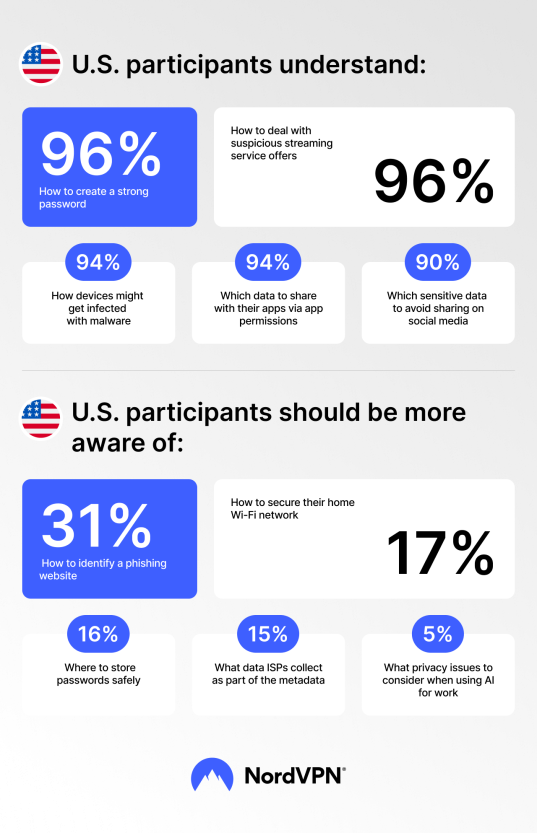
American participants showed improvement in several key areas compared to 2024. Awareness of online privacy tools increased by 7 percentage points to 37%. Recognition of AI-powered scams rose by 5 points to 76%. Ability to identify fake URLs improved by 4 points to 53%. However, understanding the security benefits of application updates declined by 3 points to 50%. This regression in update awareness presents concerning implications for vulnerability management.
Expert Recommendations for Enhanced Digital Protection
Marijus Briedis, Chief Technology Officer at NordVPN, emphasizes practical steps for improving online security:
- Implement Unique Credentials: Create distinct, complex passwords for each online account. Utilize password managers and passkey authentication where available.
- Activate Multi-Factor Authentication: Enable MFA to add crucial verification layers beyond password protection.
- Maintain Software Currency: Regularly update operating systems and applications to address security vulnerabilities promptly.
- Utilize VPN Protection: Employ virtual private networks to encrypt internet connections and protect against eavesdropping.
- Manage Privacy Configurations: Consistently review and adjust privacy settings across social media platforms and mobile applications.
- Pursue Continuous Education: Stay informed about evolving cyber threats and protection strategies through ongoing learning.
Professional Analysis: The Evolving Threat Landscape
The research findings reveal a critical disconnect between traditional cybersecurity knowledge and emerging technologies. While Americans excel at recognizing conventional threats like password security and streaming scams, the dramatic gap in AI privacy understanding (95% unable to identify risks) signals urgent need for education in new technology domains. This knowledge imbalance creates exploitable vulnerabilities as workplaces increasingly integrate artificial intelligence tools. Organizations must prioritize AI security training alongside fundamental cybersecurity education to address this emerging risk vector effectively.
Research Methodology Details
The National Privacy Test represents an open-access survey available globally. Participants from 186 countries answered 22 questions evaluating online privacy skills and knowledge. The 2025 data analysis reflects responses collected through July 31, 2025. Subsequent participation may cause slight variations in published results. Comparative 2024 data considers complete annual results rather than interim reporting periods.
About Nord Security
NordVPN operates as the world’s most advanced virtual private network service provider, serving millions of users globally. The platform offers specialized features including dedicated IP addresses, Double VPN encryption, and Onion Over VPN servers. Threat Protection Pro represents a key security feature, blocking malicious websites, trackers, and advertisements while scanning downloads for malware. NordVPN belongs to Nord Security, which recently launched Saily, a travel eSIM application. The service covers 165 locations across 118 countries worldwide.
Essential Cybersecurity Questions Answered
What represents the most significant cybersecurity knowledge gap for Americans?
Only 5% of American participants could identify privacy issues related to using artificial intelligence in workplace environments, representing the most substantial knowledge deficiency.
Which countries lead in cybersecurity awareness?
Lithuania ranks first globally (62/100), followed by Singapore and India (61/100), then Poland and Finland (60/100). The United States placed fourth overall.
What basic security concepts do Americans struggle with most?
Americans show concerning gaps in understanding metadata collection (15%), proper password storage (16%), home Wi-Fi security (17%), and phishing identification (31%).
How has American cybersecurity knowledge changed since 2024?
Positive trends include improved AI scam recognition (+5 points) and fake URL identification (+4 points). However, understanding of update importance declined (-3 points).
What immediate steps improve personal cybersecurity?
Experts recommend implementing unique passwords, enabling multi-factor authentication, maintaining software updates, using VPN protection, and pursuing continuous security education.










LEAVE A COMMENT